
A dealer or distributor does not always leave a brand before becoming a business problem. More often, the relationship weakens gradually: orders become less frequent, product coverage narrows, sales teams receive less response, and competing brands begin taking a larger share of the partner’s business.
This makes channel partner churn different from a simple partner exit. A partner can remain registered, continue attending meetings and even participate in a loyalty program while becoming commercially less valuable to the brand.
For brands that depend heavily on distributors, dealers, retailers and other intermediaries, this gradual decline can have a direct impact on revenue. An India-focused study of more than 700 channel partners across six industries found that channel networks can contribute as much as 70–80% of annual sales for leading trade marketing brands, while only 22% of surveyed partners were classified as truly engaged.
The important question, therefore, is not simply “Which partners have already churned?” It is “Which partners are showing signs of becoming inactive, why is it happening, and what can we do before valuable business is lost?”
What Is Channel Partner Churn?
Channel partner churn is the loss or decline of commercially valuable activity from a dealer, distributor, retailer or other channel partner. It can mean a partner completely stops buying, but it can also mean a significant reduction in purchase frequency, sales volume, product breadth or share of wallet.
This distinction matters because traditional churn calculations often focus on whether a partner is still active in the database. That definition can hide a more important business problem: a partner may still exist in the network while gradually shifting its business to competitors.
A distributor purchasing ₹50 lakh every quarter and then falling to ₹30 lakh has not technically churned. But if the decline continues, the brand may already be losing revenue before the distributor is formally classified as inactive.
Channel partner churn can therefore take three forms:
- Partner exit: The dealer or distributor stops working with the brand altogether.
- Partner inactivity: The partner remains enrolled or contracted but stops generating meaningful business.
- Partner decline: The partner continues purchasing but gradually reduces volume, frequency, SKU breadth or brand preference.
For most brands, partner decline is the earliest and most valuable stage to detect because there is still time to understand the cause and intervene.
Why Do Dealers and Distributors Become Inactive?
There is rarely one reason for dealer churn or distributor churn. A partner may become inactive because of economics, operational problems, changing demand, weak relationships or stronger competition.
The mistake is to treat every inactive partner as a loyalty problem. If a distributor cannot get products on time, a new reward catalogue will not solve the underlying issue.
1. Economics and margins
Channel partners constantly compare the commercial value of the brands they carry. Margin pressure, competitor incentives, slow-moving inventory and changes in scheme economics can make a previously attractive brand less relevant.
A distributor may also reduce purchases when the working capital required to hold inventory becomes too high. In these situations, declining purchases are a commercial signal that needs investigation rather than simply a request for more incentives.
2. Operational friction
Ease of doing business has a direct effect on channel relationships. Order processing, delivery reliability, claims, returns, stock availability, payment reconciliation and scheme settlement can influence whether partners continue investing their time and working capital in a brand.
India FMCG CX research found that 48% of distributors considered the order-to-fulfilment journey the most impactful interaction stage, with delivery tracking, order placement and productivity-related factors among the important experience parameters. The same research found that 20% of distributors said ease of operations influences them to invest more in an FMCG brand.
3. Weak relationship and recognition
A channel relationship can become transactional when communication is limited to orders, schemes and payment discussions. Partners may continue buying because the economics make sense, but their preference for the brand can weaken over time.
This is important because channel loyalty is not created by transactions alone. Research on Indian channel partners has identified operational excellence, rewards and incentives, recognition, learning, brand affinity, communication, well-being and events as drivers of stronger partner engagement.
4. Changing market demand
Sometimes the problem is not the relationship at all. A product category may slow down, consumer preferences may change, a competitor may launch a better proposition, or a new distribution channel may reduce the role of an existing partner.
This is why brands need to distinguish between partner performance decline and partner relationship decline. The two can look similar in sales data but require very different interventions.
The Early Warning Signs of Channel Partner Churn
The most valuable time to manage churn is usually before the partner becomes inactive.
A partner rarely moves from being a high-performing dealer to generating zero revenue without showing intermediate changes. Purchase frequency may fall first, followed by lower order values, fewer SKUs, reduced outlet coverage or declining engagement with the brand. Common channel partner churn indicators include:
- Lower purchase frequency
- Declining average order value
- Reduced SKU or product-category coverage
- Falling sales of priority products
- Lower target achievement
- Declining retailer or outlet coverage
- Reduced campaign participation
- Lower training or learning activity
- Declining reward engagement
- Fewer interactions with the sales team
- Increasing competitor presence
- Longer gaps between purchases
The important point is that no single signal proves churn risk. A distributor may place fewer orders simply because it is carrying more inventory, while another may reduce SKU breadth because a product is temporarily unavailable.
The real signal is a pattern of behavioural change across several indicators.
Churn Is a Pattern, Not an Event
A useful way to think about channel partner churn is as a progression rather than a single event.

The earlier a brand identifies the decline, the more options it has. Once a high-value distributor has completely shifted its business to competitors, reactivation can become considerably more difficult and expensive.
This principle is also supported by B2B churn research. A field study published in Industrial Marketing Management found that churn prediction can support proactive retention in B2B wholesale settings, with behavioural factors such as recency, frequency, monetary value and the recency of sales-representative contact helping identify customers at risk. The study also found that targeting customers with higher predicted churn probability reduced churn compared with random targeting and produced a positive revenue effect.
For channel businesses, the lesson is straightforward: do not wait for inactivity to become obvious before acting.
How to Measure Channel Partner Churn
A channel partner churn rate needs a clear definition of what counts as a churned partner. A basic calculation is:
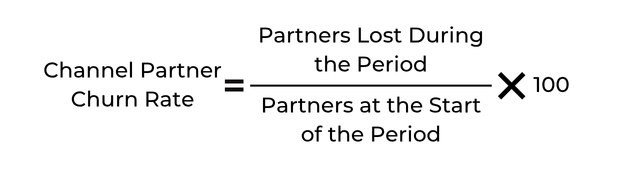
The difficult part is defining “lost.” For one business, a partner may be considered inactive after 90 days without a purchase. For another, particularly in industrial or project-led categories, a three- or six-month purchase gap may be normal.
A better approach is to define churn based on the normal purchase cycle of the channel and category. For example, an FMCG retailer may normally reorder every few days or weeks. An industrial distributor may purchase according to project cycles. Applying the same 90-day inactivity threshold to both businesses could create misleading results.
Brands should therefore track more than one churn metric.
- Partner churn rate measures how many partners become inactive.
- Revenue churn measures how much revenue is lost from those partners.
- High-value partner churn measures whether strategically important partners are becoming inactive.
- Reactivation rate measures how many dormant partners return to meaningful activity.
This distinction is important because losing 100 low-volume retailers is not necessarily equivalent to losing five high-value distributors.
Not Every Inactive Channel Partner Should Be Saved
One of the biggest mistakes in channel partner retention is treating every inactive partner as equally valuable. Retention has a cost. Sales teams have limited time, incentive budgets are limited, and reactivation campaigns require investment. A more effective strategy combines partner value with churn risk.
| Partner Value | Churn Risk | Recommended Action |
|---|---|---|
| High | High | Immediate intervention |
| High | Low | Protect and grow |
| Low | High | Automated or low-cost reactivation |
| Low | Low | Maintain efficiently |
A high-value distributor showing declining purchases should receive very different attention from a low-value inactive retailer. The first may require a sales-manager intervention, commercial review or personalized retention plan, while the second may be suitable for an automated reactivation journey.
This is why channel partner segmentation should be connected to churn management. The objective is not to save every partner at any cost; it is to protect the relationships that create meaningful business value.
How Can Brands Reduce Channel Partner Churn?
Reducing dealer churn and distributor churn starts with identifying the reason for the decline. The right intervention depends on whether the problem is commercial, operational, relational or market-driven.
If margins have become uncompetitive, the answer may involve commercial restructuring. If the problem is poor availability or delayed claims, operational correction is more important than additional rewards.
For relationship-driven problems, brands can use structured communication, recognition, learning, partner feedback and targeted engagement. For declining purchase behaviour, they can create specific reactivation journeys based on the partner’s historical value and current behaviour.
The most effective approach is usually a combination of detection, diagnosis, prioritisation, intervention and measurement.
Detect
Identify behavioural changes before the partner becomes inactive.
Diagnose
Understand why the partner’s behaviour is changing.
Prioritise
Evaluate the partner’s current and potential commercial value.
Intervene
Choose a commercial, operational, relationship or engagement intervention.
Measure
Check whether the partner’s behaviour actually recovered after the intervention.
This prevents retention from becoming a blanket discounting exercise.
Can Loyalty Programs Reduce Channel Partner Churn?
Yes, but a loyalty program should be treated as one part of a broader channel partner retention strategy.
A well-designed program can help brands identify declining engagement, recognize valuable partners, reward desired behaviours, personalize communication and create additional reasons for partners to remain active.
However, loyalty cannot compensate indefinitely for poor product availability, weak margins, delayed service or difficult business processes. If the underlying reason for churn is operational, adding more points can increase program costs without solving the problem.
This distinction is particularly important because partner engagement and partner loyalty are not identical. An India study of 700+ channel partners found that only 22% were classified as engaged, while 49% were categorized as “trapped,” meaning their relationship with the brand contained a mismatch between preference and satisfaction.
The implication is that retention requires understanding the reason behind the behaviour, not simply increasing the reward.
How Technology Can Help Predict Channel Partner Churn
The biggest technology opportunity is not simply putting loyalty points on an app. It is creating a unified view of partner behaviour.
A brand may already have purchase data in its DMS, partner information in its CRM, reward activity in a loyalty platform and sales interactions in field-force systems. When these signals remain disconnected, identifying a partner at risk becomes difficult.
A connected data layer can combine:
Transaction data + Engagement data + Partner profile + Sales activity + Reward behaviour
This allows brands to identify patterns that may not be visible in a single system.
For example, a distributor whose quarterly purchases move from ₹10 lakh to ₹9 lakh, then ₹7 lakh and ₹4 lakh may deserve attention. If that decline is accompanied by narrower SKU coverage, fewer sales-team interactions and declining campaign activity, the combined signal becomes considerably stronger.
Research on B2B churn prediction also supports the value of combining transaction behaviour with relationship data. Studies have found that recency, frequency and monetary value are useful churn indicators, while B2B-specific signals such as recent contact with a field representative can add predictive value.
The role of AI, therefore, should be to help identify which partners need attention, why they may be at risk and what intervention is most appropriate—not simply to automate another communication campaign.
Channel Partner Churn vs Customer Churn: Why the Difference Matters
A channel partner is not simply another customer.
A consumer who stops buying a product generally represents the loss of one customer relationship. A distributor who becomes inactive can affect inventory movement, retailer coverage, product availability, market reach and the sales of multiple products across a territory.
This makes channel partner retention a broader commercial issue.
The impact can also move downstream. If a distributor reduces its outlet coverage, retailers may have less access to the brand. Lower availability can then affect recommendation, secondary sales and ultimately consumer purchases.
That is why channel churn should be monitored as part of the wider channel sales strategy, rather than being treated only as a loyalty-program metric.
How to Build a Channel Partner Churn Dashboard
A useful channel partner churn dashboard should not simply display a list of inactive partners. It should help the sales and channel teams understand who is at risk, why they are at risk and what action should happen next.
At a minimum, the dashboard should track:
- Partner activity status
- Last purchase date
- Purchase frequency
- Revenue trend
- Average order value
- SKU breadth
- Target achievement
- Outlet or territory coverage
- Program engagement
- Sales-team interaction
- Partner value
- Churn-risk level
- Reactivation status
- Revenue at risk
The most useful view is not necessarily a historical report. It is a prioritised action list that tells the team which partners need attention now.
That changes the role of analytics from reporting what happened to helping the business decide what to do next.
What Should Brands Do With Dormant Channel Partners?
Not every dormant partner should receive the same reactivation campaign.
Start by separating dormant partners according to historical value, reason for inactivity and potential future value. A high-value distributor who became inactive because of a service problem requires a very different intervention from a low-value retailer who simply has not purchased for several months.
A reactivation program should also have a clear definition of success. Sending a dormant partner a message or giving them a reward is not reactivation; reactivation means the partner returns to commercially meaningful behaviour.
For example, brands can measure whether the partner places a repeat order, expands SKU purchases, restores outlet coverage or maintains activity for several subsequent purchase cycles.
The objective should therefore be sustainable reactivation, not a one-time transaction.
The Future of Channel Partner Retention
The next generation of channel partner retention will be less dependent on broad, one-size-fits-all campaigns and more dependent on behavioural signals.
Brands already have access to more partner data than they did when loyalty programs were primarily points-and-rewards systems. The opportunity now is to combine transaction history, partner activity, sales interactions and engagement signals to understand how each relationship is changing.
This is especially relevant as distributors increasingly evaluate brands on the overall ease and value of the relationship. KPMG’s India FMCG research found that 49% of surveyed distributors would switch to brands offering greater scalability, while 48% said they felt undervalued when brands overemphasized transactional activities rather than relationship-building.
That points to a broader shift in channel management. Retention is no longer simply about preventing a partner from leaving; it is about creating enough commercial and relationship value for the partner to continue investing in the brand.
A Practical Framework for Reducing Channel Partner Churn
A simple framework can help brands operationalize the process:

- Detect changes in purchase, engagement and partner activity.
- Diagnose the commercial or operational reason behind the change.
- Prioritise partners based on current value, future potential and churn risk.
- Intervene with the right combination of commercial, operational, relationship or engagement actions.
- Measure whether the partner returns to sustained commercial activity.
The strength of this framework is that it prevents brands from jumping directly from “sales are falling” to “increase the incentive.” The right response depends on why the partner is becoming inactive in the first place.
Channel Partner Churn Is a Revenue Problem
Channel partner churn is not simply the loss of a dealer or distributor. It is the gradual loss of commercial value from a relationship that may still appear active in the company’s systems.
The most effective brands will therefore look beyond the final churn event. They will monitor purchase frequency, order value, product breadth, engagement, sales interactions and other behavioural signals to identify partners whose relationship with the brand is weakening.
The goal is also not to retain every partner at any cost. It is to identify high-value partners at risk, understand why their behaviour is changing and intervene before the revenue becomes difficult to recover.
For channel-led businesses, that makes churn management a core part of sales strategy. The question is no longer simply “How many partners are inactive?” but “How much future revenue is at risk, which partners are driving that risk, and what should we do next?”
Frequently Asked Questions
What is channel partner churn?
Channel partner churn is the loss or significant decline of commercially valuable activity from a dealer, distributor, retailer or other channel partner. It can include complete partner exit, prolonged inactivity or a sustained decline in purchases, product coverage or share of wallet.
Why do channel partners become inactive?
Dealers and distributors can become inactive because of margin pressure, competitor incentives, poor product availability, operational friction, weak communication, limited growth opportunities, changing market demand or declining brand preference. The cause needs to be diagnosed before deciding on a retention intervention.
How do you measure channel partner churn?
A basic channel partner churn rate can be calculated as partners lost during a period divided by partners at the beginning of that period, multiplied by 100. Brands should first define what “churned” means according to the normal purchase cycle of their industry.
What are the early signs of channel partner churn?
Common warning signs include declining purchase frequency, lower order values, narrower SKU purchases, reduced target achievement, lower outlet coverage, declining engagement and fewer interactions with the sales team. A combination of several declining signals is generally more useful than any single indicator.
What is the difference between channel partner churn and inactivity?
Churn usually refers to a sustained loss of the commercial relationship or activity, while inactivity can be temporary. A partner may be inactive for a period because of seasonality, inventory levels or a temporary market condition, so brands should avoid classifying every inactive partner as churned.
How can brands reduce dealer churn?
Brands can reduce dealer churn by identifying behavioural decline early, understanding the underlying reason and using differentiated interventions. Depending on the cause, the solution may involve better product availability, commercial support, relationship management, training, recognition, communication or targeted loyalty initiatives.
How can brands reduce distributor churn?
Distributor retention requires attention to commercial returns as well as the ease of doing business. Brands should monitor distributor profitability, purchase trends, inventory movement, service levels, growth opportunities, scheme settlement and relationship health rather than relying only on incentive payouts.
How do you reactivate dormant channel partners?
Start by segmenting dormant partners according to historical value, reason for inactivity and future potential. Then use targeted interventions and measure whether the partner returns to sustained purchase behaviour rather than treating a single post-campaign order as successful reactivation.
Can loyalty programs reduce channel partner churn?
Yes, but loyalty programs are only one part of channel partner retention. They can support recognition, targeted rewards, communication, behavioural engagement and reactivation, but they cannot solve fundamental issues such as poor availability, weak margins or operational problems.
Can AI predict channel partner churn?
AI and predictive analytics can help identify partners who show patterns associated with future inactivity. Research in B2B settings has demonstrated that behavioural variables such as recency, frequency, monetary value and relationship activity can support churn prediction and proactive retention.
What should a channel partner churn dashboard track?
A useful dashboard should combine revenue trends, purchase frequency, order value, SKU breadth, target achievement, partner engagement, sales-team interactions, partner value and churn-risk indicators. The objective is to identify which partners require action and why, rather than simply reporting how many partners are inactive.
Is channel partner retention more important than acquiring new partners?
Not necessarily in every situation, but high-value partner retention can protect existing revenue and distribution relationships that may be expensive to replace. The most effective strategy evaluates the value and future potential of each partner instead of treating acquisition and retention as competing objectives.